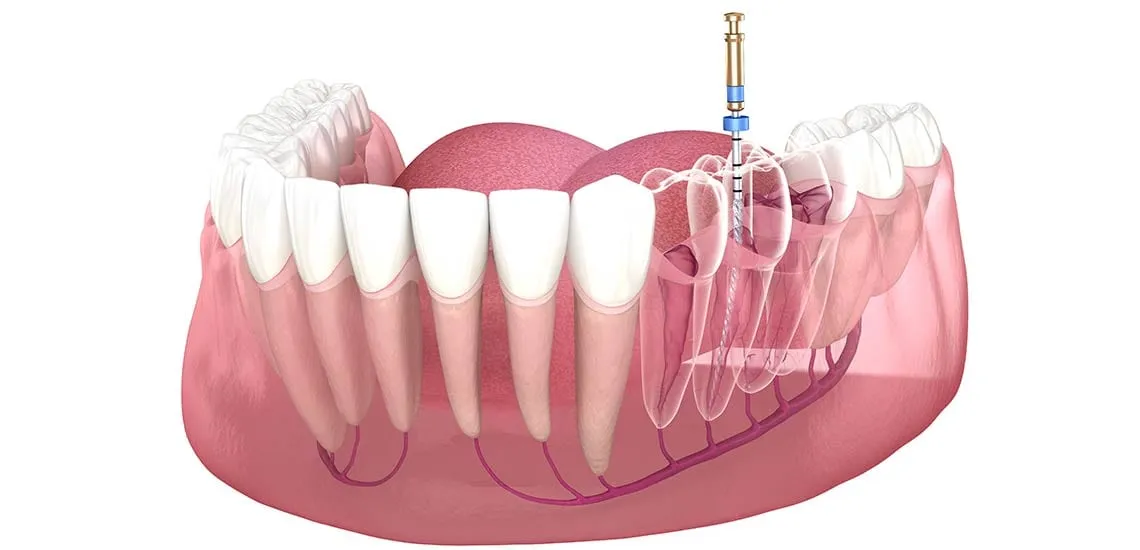
When decay or a crack lets bacteria reach the nerve, you get severe toothache, lingering sensitivity to hot or cold, or an abscess at the root tip. Root canal treatment cleans out the infected canals and seals them so the tooth can stay. That is usually a better outcome than extracting and replacing it.
Signs worth checking
- Toothache that starts on its own or wakes you at night
- Sensitivity to hot or cold that lingers
- Pain when chewing or biting
- Swollen gum or a pimple on the gum
- A tooth turning darker
Steps
- 1 Examination, X-ray and a check that the tooth can be restored with a crown
- 2 Local anaesthetic and a rubber dam to isolate the tooth
- 3 The canals are cleaned, shaped and medicated
- 4 Medication is changed at follow-up visits until the infection settles
- 5 The canals are sealed permanently, then the tooth is rebuilt with a post and crown as needed
During and after treatment
- Avoid chewing on the tooth: the temporary filling is not strong
- Tenderness on biting for 2-3 days is common; take pain relief as advised
- If the temporary filling comes out, contact us
- Get the crown done on schedule: root-treated teeth are more brittle
Common questions
The pain has gone. Do I still need to finish?
Yes. Pain stopping doesn’t mean the infection has cleared. Left untreated it can form an abscess or cost you the tooth later.
Why not just extract it?
A root canal keeps your natural tooth and the bone around it. After an extraction you’d need a replacement so neighbouring teeth don’t drift.